in the Context of Expansion and Mass Mobilization
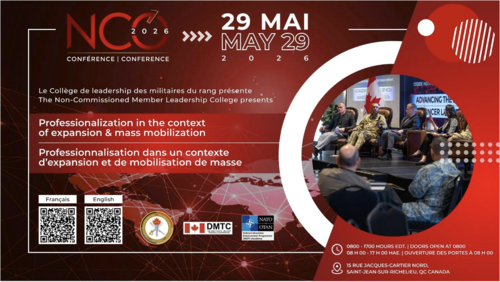
NCM Leadership College, Saint-Jean-sur-Richelieu, QC, Canada
29 May 2026
Concept
Armed Forces across NATO and partner nations are entering a renewed phase of mobilization and institutional expansion. Accelerated force generation sustained operational demands, rapid technological transformation, and increasing socio-demographic diversity within the ranks are reshaping military institutions not only in scale, but in structure, culture, and professional practice at every level.
In this context, a central question emerges:
What becomes of Non-Commissioned Officer’s Professional Identity when Armed Forces change in scale, tempo, and composition?
NCOs have long formed the connective tissue of military organizations — ensuring continuity between intent and execution, sustaining cohesion under stress, and translating institutional change into lived practice. They uphold standards in daily routines, mentor new members through experience, and render abstract directives operationally meaningful at the unit level. Yet expansion intensifies this burden. As recruitment accelerates, promotion timelines compress, expectations diversify, and complexity grows, the responsibility for maintaining standards, transmitting ethos, and preserving professional coherence falls increasingly on the NCO Corps. Professionalization under expansion is therefore not merely a structural or training issue; it concerns identity, leadership adaptation, and educational evolution. Without constant renewal of NCO professional models, expansion risks diluting the relational and experiential foundations of military effectiveness.
Co-hosted by the Non-Commissioned Members Leadership College (NCMLC), in partnership with Directorate Military Training Cooperation (DMTC) and NATO Defence Education Enhancement Programme (DEEP), the NCO Conference 2026 brings together senior enlisted leaders, commanders, scholars, and policymakers to examine professionalization under conditions of mobilization and expansion. By fostering dialogue across operational, educational, and strategic domains, the conference seeks to clarify the evolving professional jurisdiction of NCOs, strengthen leadership coherence during institutional growth, align PME with expansion realities, and ensure that the NCO Corps remains the stabilizing backbone of military effectiveness in an era of transformation.
Panels
The Conference will open with a Keynote Address delivered by Chief Warrant Officer Bob McCann, Canadian Armed Forces Chief Warrant Officer (CAFCWO). His address will frame the strategic significance of professionalization under expansion and situate the NCO Corps within the broader transformation of the CAF. Drawing on his experience at the institutional and operational levels, the CAFCWO will articulate the expectations placed upon NCO leadership in a period of growth, complexity, and cultural change. The keynote will set the tone for the conference by emphasizing the centrality of the human domain, the necessity of professional coherence, and the responsibility of NCOs to anchor standards while navigating institutional transformation.
Panel 1 - Junior NCO Leadership
Expansion is felt most immediately at the junior leadership level. Corporals, Master Corporals, and Sergeants absorb the first shock of accelerated recruitment, compressed training cycles, and generational transition. They are responsible for translating intent into daily practice while maintaining discipline, mentorship, and cohesion within rapidly expanding formations. This panel examines how junior NCO leaders sustain credibility and standards under conditions of growth. It explores how early professional socialization must evolve to preserve legitimacy, reinforce ethos, and transmit tacit knowledge when experiential gaps widen and operational tempo increases. Particular attention will be given to the relational foundations of authority and the ways junior leaders stabilize units during periods of structural change.
Panel 2 - Women Senior Enlisted Leadership
Mobilization and expansion inevitably transform the human landscape of the force. Diversification is not peripheral to professionalization — it is integral to it. In periods of rapid growth, the meaningful integration of women into senior enlisted leadership is not simply a matter of representation; it directly influences institutional credibility, talent retention, and operational capability. This panel examines the evolving and increasingly strategic role of women in senior enlisted leadership. It explores how women senior enlisted leaders shape authority within command teams, how they navigate and redefine expectations in traditionally male-dominated structures, and how their presence reshapes mentorship patterns, career pathways, and models of professional legitimacy. Particular attention will be given to the ways women leaders contribute to trust-building, conflict mediation, ethical climate, and the reinforcement of standards within expanding and diversifying formations. When effectively promoted, women senior enlisted leadership functions as a force multiplier. It broadens leadership perspectives, strengthens institutional adaptability, deepens mentorship capacity across demographic lines, and enhances cohesion within increasingly heterogeneous units.
Panel 3 Reimagining PME for 2035
Professional Military Education (PME) cannot remain static while force structures expand and operational environments grow more complex. Expansion tests not only training capacity but also the conceptual coherence of the NCO professional model across development periods. This panel explores how PME must be reimagined toward 2035 to sustain a scalable, integrated, and intellectually grounded NCM profession. Discussions will focus on aligning competency frameworks with jurisdictional clarity, preserving experiential knowledge under accelerated promotion cycles, strengthening interoperability within multinational environments, and ensuring coherence from OR-1 through OR9. The objective is to ensure that institutional growth consolidates — rather than dilutes — the professional identity of the NCO Corps, and that PME becomes a stabilizing architecture in an era of transformation.
26 May 2026
0800-1700 EDT
15 Rue Jacques-Cartier Nord
Saint-Jean-sur-Richelieu, QC, Canada
Register at this link for online or in-person attendance, before 25 May 2026